Sample clarification desk
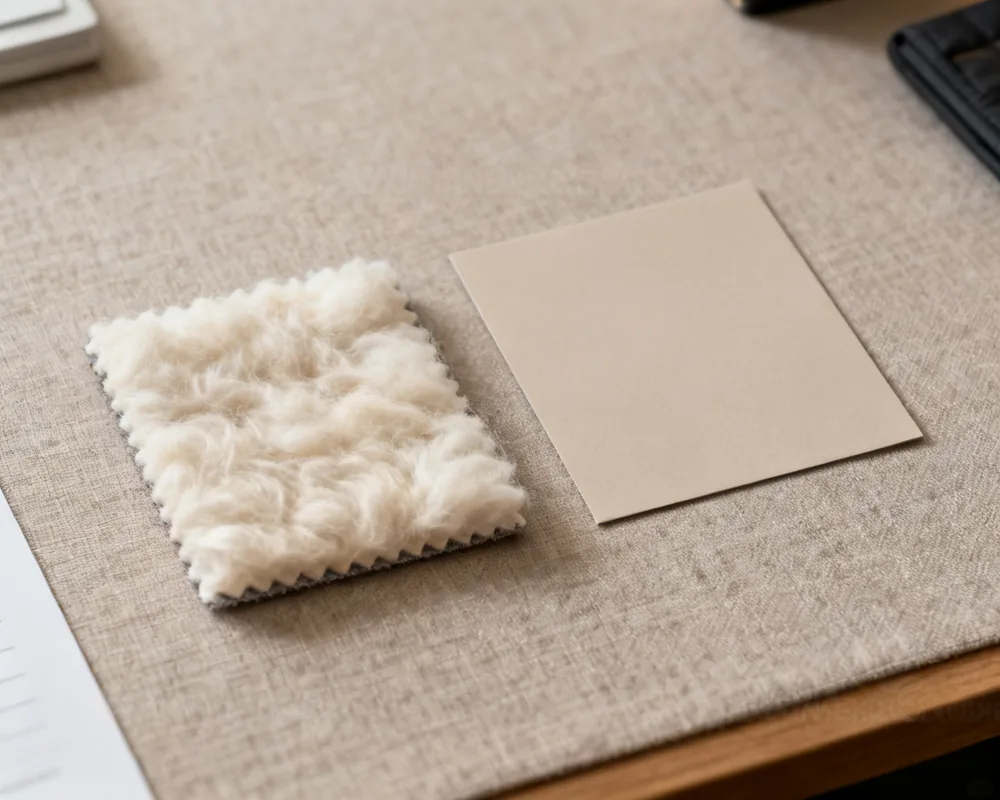
Describe the difference
An insulation enquiry becomes workable when the unchanged parts are named before the change. If the fill reference, the scrim, or the layer position should stay as they are, write that down. If only the hand, the loft appearance, or the behavior after wetting is under review, say so in that narrower way. A request that simply says warmer, lighter, or eco leaves the reviewer guessing which specimen to pull and which note to read.
PrimaLoft names that appear in search language, including gold, silver, black, and eco lines, are useful as conversation labels. They are not, by themselves, a composition statement, a fill-weight record, or a certificate. Ask which physical piece those words are meant to indicate. If you only have a finished garment, separate the shell, the insulation, and the construction of the garment so the material question is not mixed with a retail product.
- What should stay the same: fiber story, construction, scrim, or the way the piece is held in the garment?
- Which property needs review: loft, hand, a wet-state comparison, or bonding to a facing?
- How will the next sample be assessed: side-by-side handling, a named method, or a trial in the actual layer stack?
Water resistance and vapor movement do not collapse into one outdoor adjective. If damp use matters, ask for the method and the specimen condition that belong to liquid water, and a different method and condition for vapor, only when those reports exist for the insulation under discussion. Do not infer either property from a hiking story or from a shell fabric that happens to sit outside the fill.
Supply format is part of the clarification, not an afterthought. Some insulation moves as a roll, some as a packaged batt, some as a cut length. Ask which format applies to this reference and what identification travels with it. A sample conversation does not establish that a matching piece is in stock, that a roll length in metres is available, or that a delivery window has been agreed.
A workable review names four fields before anyone treats a keyword as a result: fiber composition as percent by mass, mass per unit area in g/m², the specimen state, and the method that belongs to the property under review. Liquid water may point to a hydrostatic head method. Vapor movement may point to water vapor transmission. Air permeability is a third method. Tear strength, tensile strength, and abrasion resistance do not describe hand, and a pilling or seam-slippage note does not describe loft. If the reference is a stock piece, ask for the batch and the inventory date on the record. If it is a custom development, keep sample, trial, and bulk approval as separate gates. This desk can compare a dated specimen with the proposed piece. It cannot publish a laboratory value that was never supplied.
When the reference is incomplete
State the missing field instead of treating two similar lofts as the same material. A missing fill weight, an unknown scrim, or an unstated layer position should remain a question. Comparing a dated reference specimen with the proposed piece is a selection step, and it does not promise that a sample can be sent or that bulk goods will match the hand you felt.